


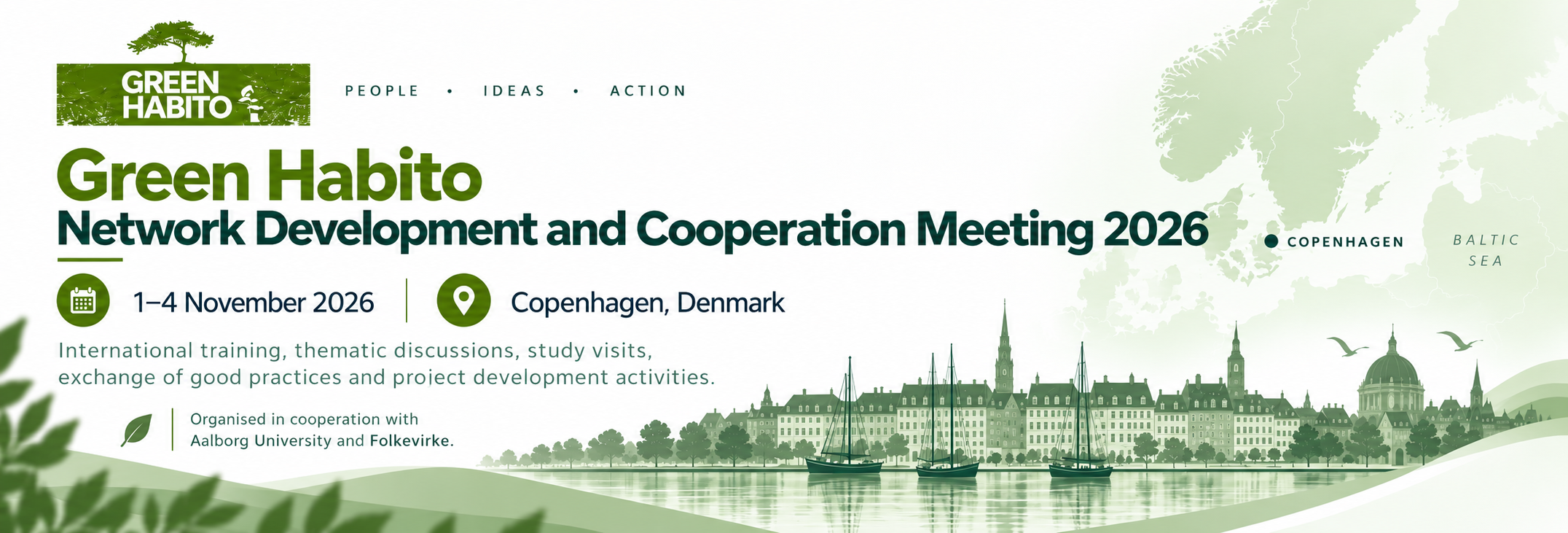
From 1–4 November 2026, members and partners of the Green Habito Network will meet in Copenhagen, Denmark for a four-day development and cooperation meeting organised in collaboration with Aalborg University and Folkevirke.
The programme will combine an international training, thematic discussions, study visits, exchange of good practices and a preparatory partner meeting for a new Nordic Council of Ministers project. Key themes include societal resilience, civil preparedness, democracy protection, sustainable development, media literacy, disinformation and hybrid threats, as well as the protection of vulnerable groups in crisis situations. Partners will also work together on the development of the “Prosperous Future” project proposal, defining its objectives, target groups, activities, expected results, budget and implementation framework. The meeting will strengthen cooperation within the Green Habito Network and support the development of future Nordic-Baltic civil society initiatives.
NB! Detailed practical information will be sent to all Green Habito Network representatives, invited key experts and guests in due course.
If you will need more detailed information please turn to key organisers: Ivan Vasilevskikh, Compass Denmark Compassdanmark@gmail.com, Annemarie Balle (info@folkevirke.dk) or Ingrid Raudsepp, management assitant of Green Habito (info@greenhabito.eu)
AGENDA
Green Habito Network Nordic–Baltic Cooperation and Development Meeting 2026
International Training, Study Visit and “Prosperous Future” Project Preparation
Dates: 1-4 November 2026
Location: Copenhagen, Denmark
Organised in cooperation with: Green Habito Network, Aalborg University and Folkevirke.
Main venues:
- Aalborg University Copenhagen: A. C. Meyers Vænge 15, Copenhagen
- Folkevirke Office: Niels Hemmingsens Gade 10, Copenhagen
Invited experts and contributors:
- Annemarie Balle, Folkevirke, Denmark
- Michael Søgaard Jørgensen, Aalborg University, Denmark
- Garba Diallo, Crossingborders, Denmark
- Ivan Vasilevskikh – Green Habito (President), Compass, Denmark
- Vassili Golikov, Sillamäe Society for Child Welfare, Estonia
- Laura Rajala, Femina, Finland
- Niko Kivinen, Kannunvalajat, Finland
- Susanne Kallanvara, Burgarden Gymnasium, Sweden
- Mira Kelber, IKF, Sweden
- German Morris, Community Development Society, Estonia
- Gunta Viksne, Shelter “Safe House”, Latvia
- Rita Liepina, Tlantu Pilseta, Latvia
1 November 2026, Arrival and Networking Day
During the day – Arrival, accommodation and registration
Participants arrive in Copenhagen and check in at the hotel.
17:00-17:30 Welcome and introduction (Annemari Balle, Michael Søgaard Jørgensen, Ivan Vasilevskikh)
- Welcome by the host organisations;
- presentation of the meeting’s objectives, programme and expected results;
- introduction of participating organisations, invited guests and experts.
17:30-18:30 Green Habito Network: achievements and future priorities (Laura Maria Rajala, Vassili Golikov)
- overview of the network’s activities and results;
- current challenges facing civil society organisations;
- priorities for resilience, preparedness, democracy and sustainable development;
- expectations for the meeting and future cooperation.
Working method: brief presentations and moderated discussion.
18:30-19:00 Networking activity: Partnership Marketplace
Participants present their organisations, expertise, target groups and cooperation needs in short rotating discussions.
19:00-20:30 Welcome dinner and informal networking
Informal exchange with Green Habito members, invited guests and Danish partners.
2 November 2026, International Training and Study Visit
Venue: Aalborg University, Copenhagen
10:00-10:15 Opening of the training day
- introduction to the training objectives;
- presentation of the learning outcomes and working methods.
10:15-11:15 Session I: Societal resilience and civil preparedness in the Nordic–Baltic region (Speakers: Michael Søgaard Jørgensen, Annemari Balle and Vassili Golikov)
- changing security environment and emerging risks;
- the role of civil society in preparedness and crisis response;
- community-based resilience and local preparedness;
- cooperation between public authorities, universities, communities and NGOs.
Working method: expert presentation, questions and discussion.
11:15-11:30 Coffee break
11:30-13:00 Session II: Protecting democracy and communities during crises (Speakers: German Morris, Estonia; Mira Kelber, Sweden and Gunta Viksne, Latvia)
- hybrid threats, disinformation and information manipulation;
- crisis communication and public trust;
- human rights and democratic participation during emergencies;
- protection and inclusion of refugees, migrants and other vulnerable groups;
- media literacy and psychological resilience.
Working method: case studies, small-group analysis and plenary discussion.
13:00-14:00 Lunch
14:00-14:30 Transfer to the study-visit organisation
14:30-16:30 Study visit to a Danish institution or civil society organisation (Linus Owman, Garba Diallo, Ivan Vasilevskikh)
- presentation of the host organisation’s work;
- Danish practices in civil preparedness and community resilience;
- volunteer mobilisation and cooperation with local authorities;
- communication with residents and vulnerable groups;
- practical tools that could be adapted in other Nordic–Baltic countries.
Working method: presentation, guided visit, questions and peer exchange.
16:30-17:00 Reflection and transferability session
Participants identify at least two practices that could be adapted by their organisations.
19:00-20:00 Dinner
3 November 2026, “Prosperous Future” Project Development and Cooperation Meeting
10:00-10:20 Review of previous discussions (Vassili Golikov)
- key lessons from the training and study visit;
- presentation of the day’s intended project-development outputs.
10:20-11:15 Session I: Common challenges and project rationale (Annemarie Balle, Susanne Kallanvaare and Vassili Golikov)
- identification of shared Nordic-Baltic needs;
- definition of the principal problem and its causes;
- relevance to civil society organisations and target groups;
- links with the UN Sustainable Development Goals and the Nordic Council of Ministers’ Vision 2030.
Working method: problem-tree analysis and facilitated discussion.
11:15-11:30 Coffee break
11:30-13:00 Session II: Project objectives, target groups and expected change (All partners represetnatives)
- formulation of the overall objective and specific objectives;
- identification of target groups and participating regions;
- inclusion of young people, minorities, migrants, refugees and vulnerable communities;
- definition of expected results, outputs and indicators.
Working method: results-chain workshop and group work.
13:00-14:00 Lunch
14:00-15:15 Session III: Activities and partner responsibilities (All parteners representatives)
- international training sessions and study visits;
- local workshops and pilot activities;
- awareness-raising and dissemination;
- expert involvement and knowledge transfer;
- allocation of partner roles and responsibilities.
Working method: thematic working groups and partner-mapping exercise.
15:15-15:30 Coffee break
15:30-16:30Session IV: Implementation, evaluation and sustainability (All parteners representatives)
- project timetable and key milestones;
- monitoring and evaluation;
- risk assessment and mitigation;
- communication and visibility;
- continuation of cooperation after the funding period.
16:30-17:30 Budget and application planning (All parteners representatives)
- main budget categories and co-financing;
- preparation of partner documentation;
- division of writing tasks;
- internal deadlines and decision-making procedures.
Expected output: an agreed project concept, preliminary work plan, partner responsibilities and application-development schedule.
19:00-20:00 Dinner
4 November 2026, Conclusions, Action Plan and Departure
09:00-09:30 Summary of the meeting
- review of the training, study visit and project-development results;
- presentation of the main conclusions by the facilitators.
09:30-10:30 Green Habito Network cooperation and development meeting (Green Habito management)
- priorities for the network’s future development;
- expansion into new countries and regions;
- involvement of new organisations and experts;
- preparations for the forthcoming network leadership elections;
- proposals for improving network governance, visibility and member participation.
Working method: strategic discussion and consensus-building.
10:30-11:45 Coffee break
11:45-12:30 Adoption of the joint action plan
- confirmation of project-development responsibilities;
- agreement on deadlines and follow-up meetings;
- identification of future funding and cooperation opportunities;
- adoption of the communication and dissemination plan.
12:30-13:00 Evaluation and closing session
- participant feedback;
- individual commitments and next steps;
- presentation of certificates and closing remarks.
13:00-14:00 Lunch
From 14:00 Departure of participants